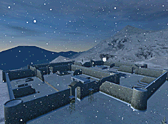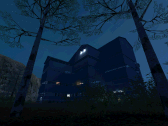
Project I.G.I.: I'm Going In is a first-person shooter made by Innerloop Studios and published by Eidos Interactive in 2000. It was followed by a sequel, IGI 2: Covert Strike. More than two decades later the first game is still played, and today it runs in a browser at playigi.com.

The studio: Innerloop Studios
The game's own credits name the developer as "Innerloop Studios - a Vision Park Company", so at the time of release the studio belonged to the Vision Park group. Eidos Interactive handled publishing, and the credits list the project leader on the Eidos side.
What Innerloop built stands out once you play it. The levels are wide open valleys and compounds with long view distances and terrain you can cross on foot, rather than a chain of narrow corridors. You can spot a guard tower a long way off through the binoculars, plan an approach, and walk the whole way there. That open design is still the heart of the game.
Release in 2000
Eidos Interactive published the game in 2000. The README that ships with it is dated 29 November 2000 and marked version 1.0. The name the game used depended on the build: in the English build the main menu button reads "Play Project IGI", while the US build reads "Play I'm Going In". The game shipped with English, French, German, Italian and Spanish text, and the US English build hid the language option.
The PC it asked for was modest even then: Windows 95 or 98, a Pentium II at 300 MHz, 64 MB of RAM, a DirectX 7.0a 3D card with 8 MB of video memory, a 4x CD-ROM drive and 500 MB of disk space. The recommended setup was an Athlon or Pentium III, 128 MB of RAM, a card with 16 MB of video memory and an 8x drive. The README also notes that the game runs fine in 64 MB, but smoother the more memory you have.
What the game was
You play David Jones, an IGI agent, guided over the radio by his handler Anya. A nuclear warhead has been stolen, and Josef Priboi is the only link to the heist. Jones follows the trail from Josef to his uncle, the arms dealer Jach Priboi, known as "Jach the Hammer", and on to Ekk, who uses an old KGB redoubt in the ruins of a castle as a training camp. Along the way Jones works with Captain Harrison's backup team, takes the call sign "God" as a sniper in mission 4, is shot down near the border and loses his gear, and finally follows Ekk to a nuclear research plant.
The campaign has 14 missions on Easy, Medium or Hard. They run from a trainyard and a SAM base to Ekk's castle, the Eagle's Nest, and a nuclear base. For the full plot and cast, see the story and characters guide; every briefing is on the Missions page.
How the game played
IGI 1 was a single-player game only, with no multiplayer mode. It also had no saving inside a mission: you finish a mission to open the next one, and if you die you start that mission over. One mistake late in a long mission means replaying all of it, so the game rewards patience.
The approach is the game. You pick your route, scout with binoculars, use the map computer to see guards from above, and decide whether to go in quietly or loudly. Alarms, cameras and patrols punish a careless run, while a careful one can clear a whole base before anyone knows you are there. If you want to play it that way, the stealth tips guide covers the basics.
IGI 2: Covert Strike
The sequel, IGI 2: Covert Strike, keeps the Priboi name alive: one of its missions is called "Priboi's Villa". It has 19 missions split into three campaigns of seven, six and six.
- Campaign 1 runs from "Infiltration" and "Deep in the Mines" through "The Weather Station", "Bridge Across the Dnestr", "Ambush" and "Production Facility" to "Border Crossing".
- Campaign 2 opens with "Libyan Rendezvous", then "Prison Escape", "Priboi's Villa", "The Airfield", "Zaleb's Stronghold" and "Showdown at the Docks".
- Campaign 3 runs from "Island Assault" and "Air-Strike" through "The Ancient Temple", "Secret Weapons Lab" and "Mission Control" to "The Launch Pad".
The biggest change from the first game is that IGI 2 added online multiplayer. The single-player campaign kept the same idea of large maps and careful approaches. You can read every IGI 2 briefing and objective in the IGI 2 missions guide.
A favourite in South Asia
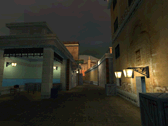
Project IGI has kept a large following in South Asia long after its release. That audience is a big part of why the game is still alive, and it is why the browser version added languages the original never had. Alongside the five original languages you can play in Hindi, Urdu, Roman Urdu and Sinhala, plus Russian, Vietnamese and Portuguese. Menus, objectives, messages and subtitles are translated; the spoken voices stay in English.
The original PC game today
The 2000 game was built for Windows 95 and 98 and DirectX 7, so getting it to run on a modern PC can take some work. If you still have your own copy, our Windows 10 and 11 guide covers the usual fixes.
How it lives on at playigi.com
playigi.com is the first and original browser port of Project I.G.I.: I'm Going In, made by Sachal. It runs the original game's missions, maps, characters and text in a web page on PC or phone, with nothing to download or install. All 14 missions are there on Easy, Medium and Hard, and optional HD textures by the Neonix Modding Team can be switched on in the settings.
The port also adds the multiplayer the 2000 game never had: co-op to play the missions together, and Team Deathmatch rooms you can join straight from the menu. See the multiplayer and co-op guide for how it works, and About playigi.com for more on the port itself. Copies of the site exist, but the only real address is playigi.com.
Want to see why people still talk about it? Play Project IGI in your browser and start where it all began, at the Trainyard.